
In 2025, PlatCore crossed a threshold that many learning platforms aspire to—but few achieve. Their first customer surpassed 1 million registrations and achievements in a single year, while across the customer base PlatCore saw a 67% year-over-year increase in registrations and a 51% increase in completions compared to 2024.
These are not vanity metrics. They are indicators of something deeper: sustained adoption, operational trust, and the ability to deliver learning at scale without friction.
This level of adoption, throughput, and sustained growth is not achievable with a traditional LMS architecture. It is the direct result of running a native LMS on the ServiceNow platform, where users, data, workflows, and automation already live.
Why These Usage Metrics Matter (And Why They’re Not Vanity Metrics)
In many LMS platforms, registrations and completions primarily reflect forced activity—assigned compliance courses, annual check-the-box training, or one-time onboarding programs.
PlatCore’s 2025 metrics tell a very different story.
Adoption Beyond Mandatory Training
A meaningful portion of registrations and completions came from:
- Learners browsing catalogs
- Learners self-selecting content
- Learners returning month after month
This signals true adoption, not just obligation. Learners engage because:
- The system is familiar
- Access is seamless
- Content is relevant to their role
That familiarity comes from one critical fact: learners are already in ServiceNow.
There is no new system to learn, no new credentials to remember, and no disconnected interface to navigate.
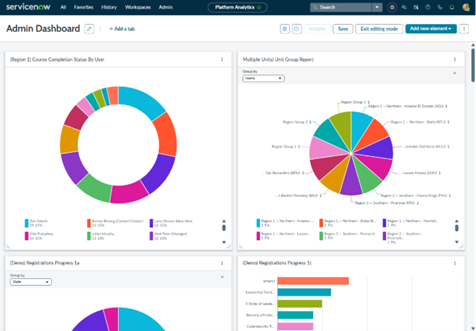
The Core Differentiator: Learning Built Inside ServiceNow
The single biggest driver behind PlatCore’s 2025 growth is architectural, not cosmetic.
PlatCore is not integrated to ServiceNow.
It is built natively on ServiceNow.
That distinction unlocks four capabilities that traditional LMS platforms cannot replicate.
1. Automation Without Integration Overhead
No User Syncs. No Manual Uploads. No Delays.
In most LMS environments, user management is a constant operational burden:
- CSV uploads
- API syncs
- Scheduled jobs
- Missed updates
With PlatCore:
- Users already exist in ServiceNow
- Organizational data already exists in ServiceNow
- Job changes, promotions, and transfers are already tracked
As a result:
- LMS admins do not “manage users”, they create value
- New hires receive training automatically
- Learners never fall through the cracks
This automation is not layered on. It is inherited directly from ServiceNow’s data model .
2. Personalization at Scale Through Live Organizational Data
Automation alone does not drive engagement, but relevance does.
Because PlatCore sits on ServiceNow’s live data, learning assignments can be dynamically personalized based on:
- Job titles
- Job codes
- Departments
- Locations
- Employment status
Dynamic Assignments Change the Economics of Learning
Learning admins can:
- Assign training to the entire organization with one click
- Target highly specific populations just as easily
- Trust that assignments update automatically as users change roles
This is personalization without complexity—and it’s a major reason completion rates continue to climb.
Traditional LMS platforms simply don’t have access to this depth of real-time organizational context.
3. Acceleration: Time-to-Value Measured in Weeks, Not Months
One of the clearest patterns in 2025 was how quickly customers moved from implementation to production learning.
Training Live in Two Weeks
One government customer installed PlatCore and began delivering training in under two weeks.
Why was this possible?
- Users were already in ServiceNow
- Organizational structure was already defined
- Identity, access, and roles already existed
- Content simply needed to be connected
The LMS did not need to be “stood up.”
It was activated .
This acceleration directly correlates with higher annual usage numbers—customers start delivering value sooner, and they keep building momentum.
4. Scale in Practice: A Case Study
Perhaps the clearest proof point that these metrics require a native LMS comes from one of PlatCore's enterprise insurance customers.
Moderate User Base. Massive Throughput.
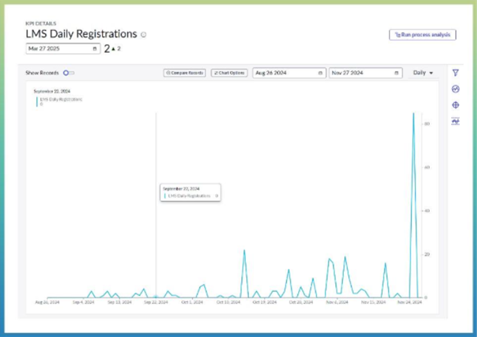
This customer supports roughly 7,000 users, yet recorded:
- Up to 180,000 registrations in a single month
- Over 1 million completions in a year
The company uses PlatCore to deliver monthly upskilling to insurance agents—focused on:
- Product updates
- Sales techniques
- Objection handling
Agents are incentivized for completing training, a cost the company willingly absorbs because the ROI is clear: better-trained agents drive higher profitability .
This level of throughput would overwhelm a traditional LMS. In PlatCore, it’s business as usual—because ServiceNow already handles the scale.
Government and Commercial Growth: Different Drivers, Same Foundation
While use cases differ, both sectors benefit from the same underlying architecture.
Government: Compliance at Population Scale
Federal, state, and local agencies use PlatCore to:
- Automatically assign compliance training
- Track completions in real time
- Prove audit readiness
One federal customer exceeded a 95% compliance target, reaching 97% completion, because:
- New employees are assigned training on day one
- No manual intervention is required
- Reporting is continuous and accurate
This is compliance without chaos—and it is only achievable when learning is part of the system of record .
Commercial: Performance, Revenue, and Speed
Commercial customers use the same capabilities to:
- Upskill sales teams
- Enable partners and resellers
- Reduce time-to-productivity
The difference is not the platform—it’s the objective. In both cases, scale is achieved because learning operates at the same speed as the business.
Consolidation: The Next Multiplier for Usage Growth
In 2025, most customers were still replacing a single LMS. Looking ahead, consolidation is emerging as a major driver of future growth—especially in government.
Many large agencies operate:
- Multiple LMS platforms
- Multiple admin teams
- Multiple contracts and integrations
By consolidating onto a single, native LMS on ServiceNow:
- Licensing costs are reduced
- Reporting becomes unified
- Security posture improves
Several major consolidation initiatives are already planned for 2026, positioning PlatCore for another step-change in scale .
Who These Milestones Matter To—and Why
Business Owners:
- Higher productivity
- Improved revenue performance
- Reduced operational risk
Technology Owners:
- Fewer systems to manage
- Lower integration and support costs
- Alignment with enterprise IT strategy
Learning Administrators:
- Automation replaces manual work
- Time shifts to content and strategy
- Confidence in scale and reporting
Learners:
- Familiar interface
- Seamless access
- Relevant, role-based training
What 2025 Ultimately Proves
From 521,000 registrations in 2023, to 899,000 in 2024, to 1.5 million in 2025, PlatCore’s growth is not accidental.
It is the natural outcome of:
- Learning built on live enterprise data
- Automation inherited from ServiceNow
- Personalization without complexity
- Acceleration through native architecture
- Scale without operational overhead
These milestones are not just about growth.
They are proof that learning at enterprise scale is only possible when the LMS is truly native to the platform that runs the business.
And in 2025, PlatCore proved exactly that.
Looking to scale your LMS on ServiceNow? Let’s talk.
PlatCore is the only LMS built natively on the ServiceNow platform. Let us show you how the power, flexibility, and security of a native ServiceNow LMS can transform your training.
Let’s Talk
---------------------------
About PlatCore LMS
Built natively on ServiceNow, the PlatCore LMS enables secure, scalable, and integrated enterprise learning. From compliance to IT, HR, and customer training, PlatCore lets teams manage learning directly within ServiceNow — no third-party integrations needed. Its modern architecture supports automation, analytics, and AI-driven insights, reducing overhead and boosting engagement. Trusted by governments and enterprises, PlatCore unifies training with the systems teams use every day.